Burlingame Eichlers / Tract index
About forty subdivisions
Eleven thousand houses, and Burlingame has about a hundred of them.
Which is roughly nine-tenths of one per cent of everything Eichler built. That is the context for every other page on this site: Mills Estate is not a small corner of a famous tract, it is one of the smallest tracts there is, and it is the reason nobody has written a book about it.
House counts for Eichler tracts are estimates, not censuses, including ours. Nobody — not Eichler Network, not the archives — holds a parcel-level list. Treat these as orders of magnitude.
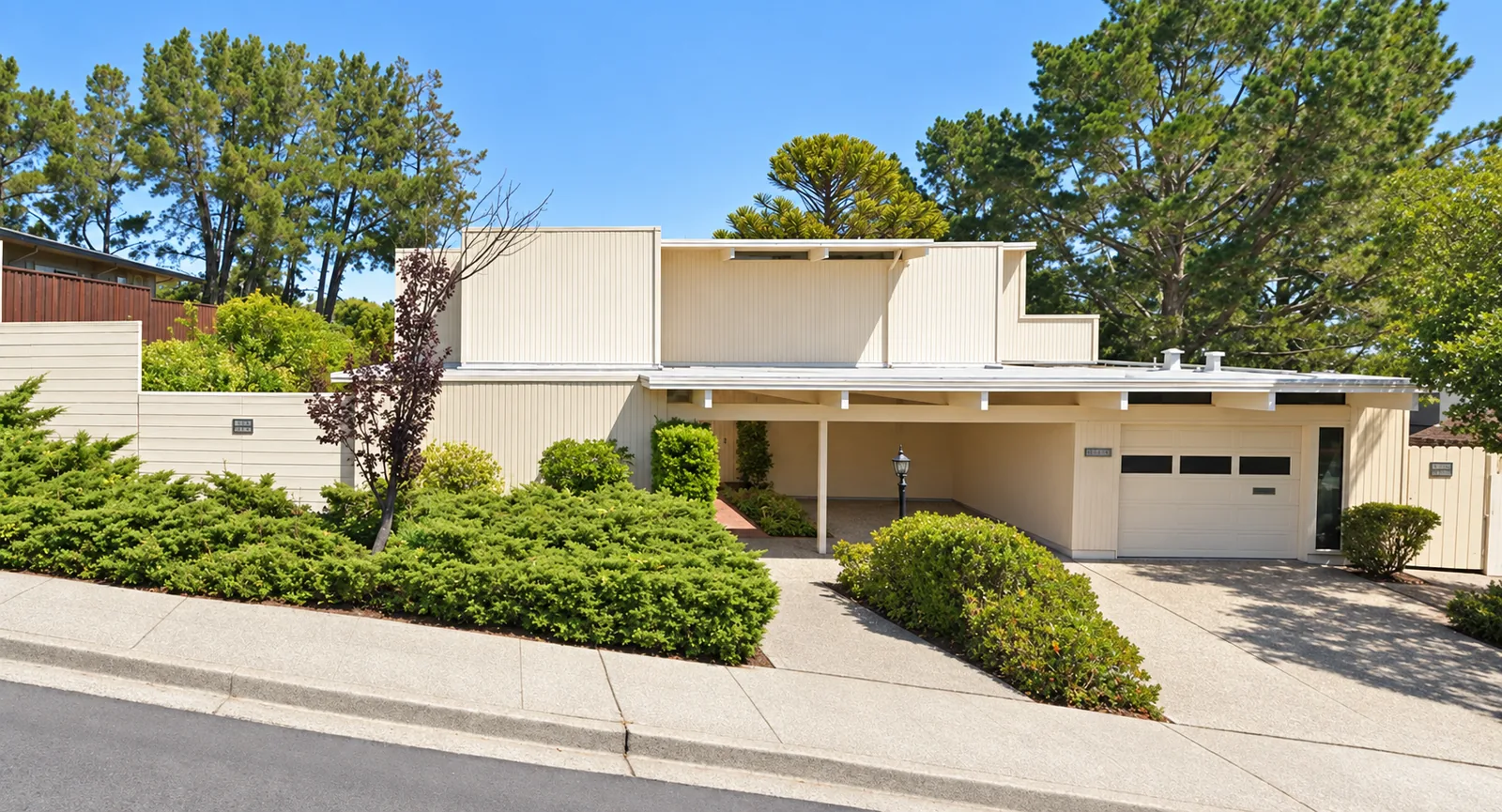
The Peninsula
San Mateo County and the mid-Peninsula.
| Tract | City | From | Note |
|---|---|---|---|
| San Mateo Highlands | San Mateo (unincorporated county) | 1955 | ~740 houses — the largest single tract. Contains the X-100 steel house (1956) and Belluschi's Life House (1958). Compared → |
| Mills Estate | Burlingame | 1963 | ~100 houses, built 1964–65. Claude Oakland. City jurisdiction. This site → |
| Stanford Gardens | Menlo Park | 1949 | A dozen houses. Where radiant heating was introduced. |
| Atherwood | Redwood City | 1949–50 | Early work. |
| Ladera | Portola Valley | 1951–52 | 25 houses. Jones & Emmons' first built Eichler work. |
| Lindenwood | Atherton | 1951–52 | The upscale end — $42,500 to $49,500 when new. |
| Foster City | Foster City | 1960s | Built on engineered fill, on flat reclaimed land. Compared → |
The South Bay
Where it started.
| Tract | City | From | Note |
|---|---|---|---|
| Sunnyvale Manor | Sunnyvale | 1949 | The first Eichler tract — 36 houses, April 1949. Phase two is where post-and-beam arrives. |
| Sunnymount Gardens | Sunnyvale | 1949 | 36 houses. First use of the “Eichler Homes” name. |
| University Gardens | Palo Alto | 1949 | 50+ houses — Josina, Kendall, Barron. |
| Green Gables | Palo Alto | 1950 | “Subdivision of the year.” National Register. |
| Fairmeadow | Palo Alto | 1953 | Where the second bathroom became standard. |
| Greenmeadow | Palo Alto | 1954 | First Eichler community centre, pool and nursery school. National Register. |
| Pomeroy West / Green | Santa Clara | 1961 | Townhouses. |
East Bay, Marin, and beyond
Everywhere else.
| Tract | Where | From | Note |
|---|---|---|---|
| Terra Linda | San Rafael, Marin | 1955 | National Register. Where Eichler went door to door in 1955 and offered to buy back the houses of anyone who objected to a Black neighbour. Nobody accepted. |
| Rancho San Miguel | Walnut Creek | 1955 | National Register. |
| South Land Park | Sacramento | 1955 | Only about 60 houses built. |
| Strawberry Point | Marin | late | Part of the late group with Burlingame and Walnut Grove. |
| Walnut Grove | Walnut Creek | late | Documented for its clipped gables — another late roof experiment, like Burlingame's folded plate. |
| Harbor Point | Marin | 1964 | |
| Diamond Heights | San Francisco | 1962 | Two-storey row houses with atriums. |
| Thousand Oaks, Granada Hills, Orange | Southern California | 1961–66 | Two Granada Hills houses are Los Angeles Historic-Cultural Monuments. Sources disagree on whether expansion began in 1961 or construction ran 1964–66. |
| Chestnut Ridge | Ramapo, New York | 1962 | 140 acres bought, 216 houses planned, three built. No source we found explains why it failed. |
Reading the list
The date tells you most of what you need to know.
1949–50 gets you the earliest work: small, around a thousand square feet, steel radiant tubing, and the transition from plan-book houses to architecture happening mid-tract.
1951–58 is the classic period — two bathrooms, aluminium sliders, the arrival of the atrium, and the experiments that produced the X-100 and the Life House.
1960–65 is Claude Oakland's era, and the houses get bigger, the roofs get stranger, and the plan vocabulary expands into galleries, loggias and entry courts. Burlingame sits here, at the end of it.
What late means for the house you own → · Burlingame, the Highlands and Foster City, compared →
Talk to us
Looking outside Burlingame?
We sell Eichlers across the Peninsula and we keep sites like this one for several of these tracts. Tell us which you are considering and we will tell you what the trade-offs actually are.