Burlingame Eichlers / Against Foster City
Ridge against fill
One tract sits on rock. The other sits on eighteen million cubic yards of dredged sand.
Foster City is not a neighbourhood built on land. It is land built to be a neighbourhood — pumped out of San Bruno Shoal, twenty-four hours a day for six years, onto a dairy island behind a dike. Everything about the Eichlers there follows from that.
Burlingame
Ridge
Hillside lots, 7,840–15,200 sq ft, bay views
Foster City
~8 ft
Above sea level, on engineered fill, behind a levee
How Foster City was made
A dairy, a salt company, and a six-year dredging operation.
- 1890sWilliam P. A. Brewer buys part of a diked 5,000-acre tract and runs the San Mateo Ranch Dairy on it. The Brewers sell most of it to Leslie Salt in the 1940s.
- 1958T. Jack Foster takes a $200,000 option on Brewer's Island.
- 1960Foster and his three sons buy roughly 2,600 acres — a little under twelve million dollars, by one account. The Estero Municipal Improvement District is created by the legislature to govern the development.
- 1960–66Eighteen million cubic yards of sand dredged from San Bruno Shoal and pumped onto the island — seven days a week, twenty-four hours a day, for six years, at twelve to sixteen thousand cubic yards a day. The ground rises roughly four and a half to six feet, to about eight feet above sea level.
- 1963First Eichlers sold. Original prices $28,500 to $30,950.
- 2018Measure P passes — a $90 million bond to raise the levee, after FEMA warned it was neither strong enough nor high enough.
- 2023–24Levee complete: 6.2 miles, about six feet higher. The City now reports FEMA has accredited it and the area is Zone X, with no mandatory flood insurance.
Verify the flood status yourself before you rely on it. Two City pages disagreed at the time we checked — the levee-project FAQ described the map revision as pending, the Public Works page describes the levee as certified. Public Works is the more current. Separately, private flood models still score these properties at a twenty to thirty per cent chance of a flood reaching the building over thirty years, and buyers will see that number on the portals whatever FEMA says.
The rules
Foster City controls exteriors more tightly than anywhere else on the Peninsula.
A Foster City planner, quoted in CA-Modern: “In Foster City any exterior change is subject to review by the city,” with attention to keeping the original Eichler character. Every neighbourhood has a city planning permit for almost any exterior change governing what may be changed outside — a requirement that does not exist in neighbouring San Mateo or Redwood City.
So the ranking on freedom runs: San Mateo Highlands (no control at all, unincorporated county) → Burlingame (city residential design review) → Foster City (a planning permit for almost every exterior change).
A correction worth carrying: one widely used Eichler reference site marks all three Foster City tracts as having a homeowners association. The single-family Eichlers do not — listings in both Treasure Isle and Bay Vista show zero HOA dues.
The associations that exist under those names are later and different: Treasure Isle HOA, 155 units, built 1971. Marina Point HOA, 364 units, 1976. The Eichlers are 1964–68. It is a name collision, and it matters, because “does it have an HOA” changes the monthly number a buyer underwrites.
The three clusters
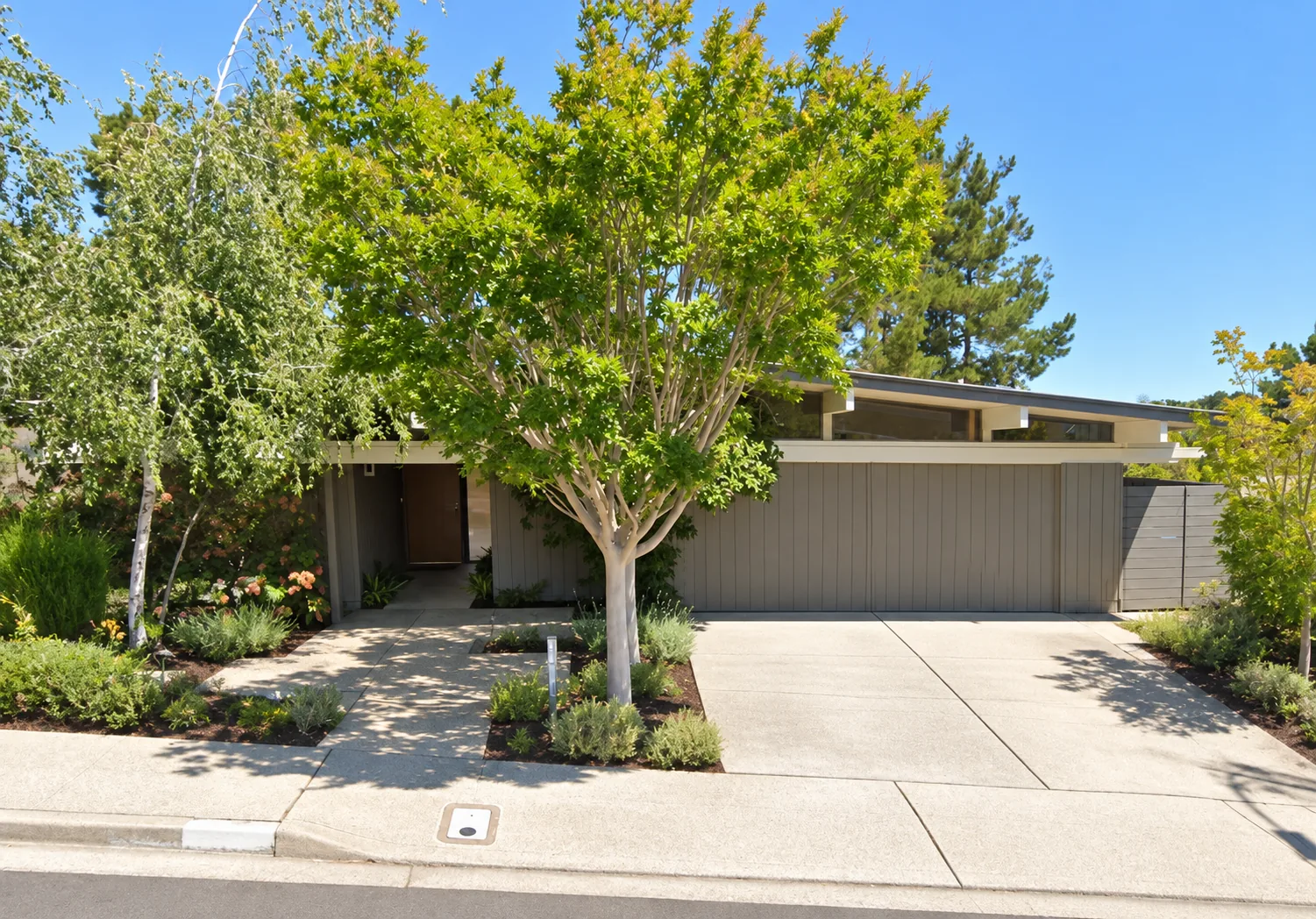
Foster City does not have an Eichler neighbourhood. It has Eichlers in three places.
| Cluster | Streets | Built | Notes |
|---|---|---|---|
| Treasure Isle Neighbourhood 1 |
Ship names — Matsonia, Lurline, Pilgrim, Constitution | From Nov 1963 | Foster City's oldest residential neighbourhood. Matsonia and Lurline are Matson Line ships. Eichler count not published. |
| Bay Vista Neighbourhood 2 |
Bird names — Gull, Puffin, Curlew, Loon | 1964–66 | Described as the largest of the three. Five Eichlers face the bay on Beach Park Boulevard, visible from the levee trail. |
| Marina Point Neighbourhood 4 |
Rig names — Schooner, Barkentine, Yawl, Mainsail, Foresail | 1967–71, mostly 1968–69 | The last Eichler work in Foster City. About fifty homes, per a source we could not corroborate. |
The scattering was deliberate policy, not a sales accident. Foster sold builders “limited numbers of scattered lots in a given neighbourhood so that no one area looked too homogeneous” — the City's own consultant report says so. Kay Homes, Duc & Elliot and Eichler were interleaved on purpose.
Which put Eichler somewhere he had never been: “Never before had he been part of someone else's development and required to build their contemporary one-story houses in and around conventional-looking homes.” Burlingame was a milder version of the same thing — Eichler building inside Trousdale's 1954 subdivision. On that →
The architecture got stranger for it. One Foster City model puts the atrium surrounded on all sides by interior space rather than open to the front — an owner calls it “like a fish bowl.” Some 1968 houses keep tiki-style outrigger beam ends at the ridge. One model has a front door with a sloped top instead of a rectangle.
The documented plans there are FC-13 and FC-23 (Claude Oakland) and FB-4 and FB-4S (John Brooks Boyd), from the original sales brochure — the prefix encodes the architect. Burlingame, by contrast, has no documented plan number at all.
The reason Eichler was there at all
“With one stroke.”
With one stroke, by bringing Eichler into Foster City we effectively announced to the world that no one would be denied the opportunity to own a home in Foster City because of race.
The City's own consultant report corroborates it independently: Eichler “was also an advocate for inclusion and sold his homes to whoever wanted to buy one, which met with opposition in the racially segregated 1950s and 60s,” and for the Foster City houses he advertised in the Chinese Times in San Francisco.
This is the same thread that runs through Burlingame. Eichler had resigned from the San Francisco builders' association in 1958 over exactly this. And the man who opened Mills Estate for him in 1963, Jonas Harschel, had left a thirty-thousand-dollar career to work for Eichler because he detested his colleagues' attitudes on race — having escaped Holland in 1940 and lost sixty people to the Holocaust.
Two tracts, four years apart, same reason.
Talk to us
Looking at both?
Ridge or water is usually the real question, and it is not a close call once you know which one you are. Tell us how much you intend to change the house and we will tell you which city makes that easy and which makes it slow.
Correction, 18 September 2026
We had called this a “filed prototype.” That is not what we can source.
Earlier versions of this page said every exterior change in Foster City went through a design-review prototype filed with the city. Checking it, what the city actually publishes is narrower and broader at once: a planning permit is required for almost all exterior changes, and the framework behind that is mid-rewrite into Objective Design and Development Standards whose adoption date our sources give differently. The comparison still holds — Foster City is the one of the three where the city has a say in your windows — but the mechanism is not what we described. The full finding, with dates →