Burlingame Eichlers / Jonas Harschel
8 Mariposa Court · 1964–2021
The salesman who stayed.
Jonas Harschel opened this tract for Eichler Homes, built himself one of its houses, and lived in it for the rest of his life. His widow Cora stayed another fourteen years after him. When 8 Mariposa Court finally came to market it was the first time that house had ever changed hands.
Everything on this page traces to Eichler Network's reporting — two articles by the same publication. It is a good source and we have no reason to doubt it, but it is a single source. We could not find an independent obituary or death record. Read it as well-reported rather than multiply-confirmed.
April 1940
He got out. Sixty people he knew did not.
Harschel was Dutch and Jewish, and he left Holland in April 1940 — weeks before the German invasion. Sixty members of his family and circle were killed in the Holocaust.
He came to California and, by the 1950s, was doing well: building, and earning thirty thousand dollars a year in insurance. In 1952 he had a house in Belmont designed for him by Bill Patrick — a two-bedroom triangular house on three levels.
In 1960 he walked away from that income to sell tract houses for Joseph Eichler. His stated reason was not money and not architecture:
I detested my colleagues' attitudes on social and political issues.
Two bedrooms, one bath, for under $11 thousand. A stupendous bargain compared to what I was building.
Why it fits
He picked the one builder in California who would sell to anybody.
Two years before Harschel joined, on 1 July 1958, Joseph Eichler resigned from the San Francisco home builders' association because it would not adopt a non-discrimination position. At that point his company had, in the language of the period, sold homes to twelve Black families and more than two hundred to buyers of Asian descent.
Eichler's statement at the time: “Eichler Homes in no way practices any kind of discrimination,” and of his fellow builders, “I am sure that most are as much against discrimination as I am, but I think they are either bound by custom or fear of financial loss.”
He had sold his first house to an African American buyer in the early 1950s — by one account a Black family at Greenmeadow, Palo Alto, in 1954. He consulted with the FHA and HUD and testified before the U.S. Commission on Civil Rights.
All of that predates California's Rumford Fair Housing Act, which was enacted in 1963, gutted by Proposition 14 in 1964, and restored when the California Supreme Court struck Prop 14 down in 1966. (Several accounts date Rumford to 1966. That is the court ruling, not the Act.)
So when a man who had escaped the Nazis went looking for a builder to sell for, the choice was not arbitrary. Foster City is where this thread runs next →
The house
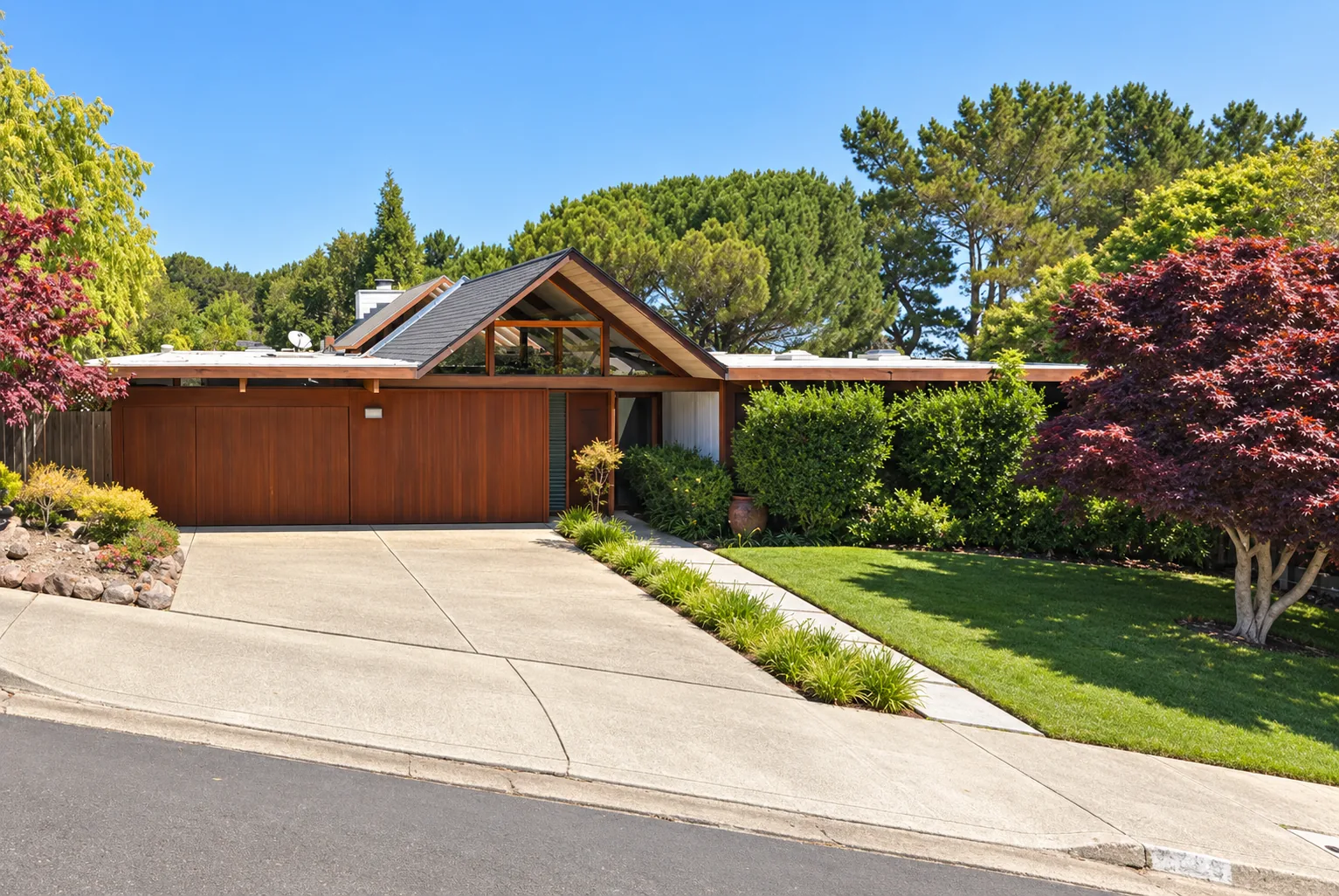
8 Mariposa Court.
Harschel opened Mills Estate for Eichler in late 1963 and took a house in it. His was Jones & Emmons — not Claude Oakland, who drew most of this tract — at 2,135 square feet, five bedrooms, two baths.
What was in it, as reported: radiant heating in the slab, vaulted open-beam ceilings, window walls, Philippine mahogany panelling, a built-in concrete block fireplace, a pool with a custom pool house, a built-in outdoor fireplace, and views to the bay and the East Bay hills. The 1964 kitchen was still entirely original when the house was described.
He died in 2007. Cora Harschel died in 2021. The house was listed at $3,299,950 — its first sale in fifty-seven years.
Years in the house
57
1964 to 2021, one family, never sold
Family lost
60
Relatives and friends killed in the Holocaust
One small inconsistency worth naming: the source says the tract “opened in late 1963” and elsewhere describes an “all-original 1964 Eichler kitchen.” Both can be true — sales open, house completes the following year — and the county record for the tract supports exactly that pattern. We mention it because we would rather you saw the seam than didn't.
An independent record of Harschel — an obituary, a death notice, anything not published by Eichler Network. Documentation of which other Eichler tracts he opened, since “sales manager” implies more than one. And anything at all from the family: photographs of the opening, sales material, the price list he worked from.
If you bought 8 Mariposa Court, or know who did, we would like to talk to you — not to list it, but because that house is the best-documented object in this tract and its papers may still exist.
Talk to us
Did you know the Harschels?
Or anyone who bought here in 1964. We are assembling a sourced history of this tract and the people who were there are the only remaining source for most of it.