Burlingame Eichlers / What it's worth
A hundred houses · a handful of sales a year
This tract is too small to have a median.
In the San Mateo Highlands we can run a rolling twelve-month Eichler-only cohort and get something defensible, because that tract sells two to five houses a month. Mills Estate is roughly a hundred houses. Run the same calculation here and you are averaging three sales and calling it a market.
The 94010 baseline, the Eichler-specific adjustments priced one at a time, and the actual comparable set for your house — named addresses, not a headline number. The working is the product.
The arithmetic problem
Why every number you have read about this tract is noise.
A hundred houses in a stable, tightly held Burlingame neighbourhood turn over at something on the order of three to six sales a year. That is the entire annual sample. One estate sale of an unmodernised original, one fully rebuilt house with a new kitchen and a foundation retrofit, and your “median” has moved by six figures for reasons that have nothing to do with the market.
Portal neighbourhood pages make it worse, not better. They draw a polygon that is not the Eichler tract — because no published Eichler boundary exists for it — and then median everything inside the polygon. You get a number built mostly from conventional 1950s hillside houses with an Eichler or two mixed in.
So the honest structure is: measure the 94010 market, where the volume is real, and then price what makes this house different from that market, one factor at a time, with reasons attached.
That is a slower answer. It is also the only one you can argue with. If we hand you a single number, you can take it or leave it. If we hand you six adjustments, you can tell us the third one is wrong — and sometimes you will be right.
The adjustments
What actually moves the number on an Eichler here.
Ranked by how much we have seen each one move a sale in this architecture on the Peninsula. Direction is reliable; magnitude is house-specific, which is why there are no percentages printed here.
| Factor | Why it matters in this tract specifically | Direction |
|---|---|---|
| How much original house is left | The buyer paying the top of this market is buying an Eichler, not a 2,200 sq ft house that used to be one. Dropped ceilings, filled-in glass walls and a boxed-in entry court remove the reason they came. | Largest single factor |
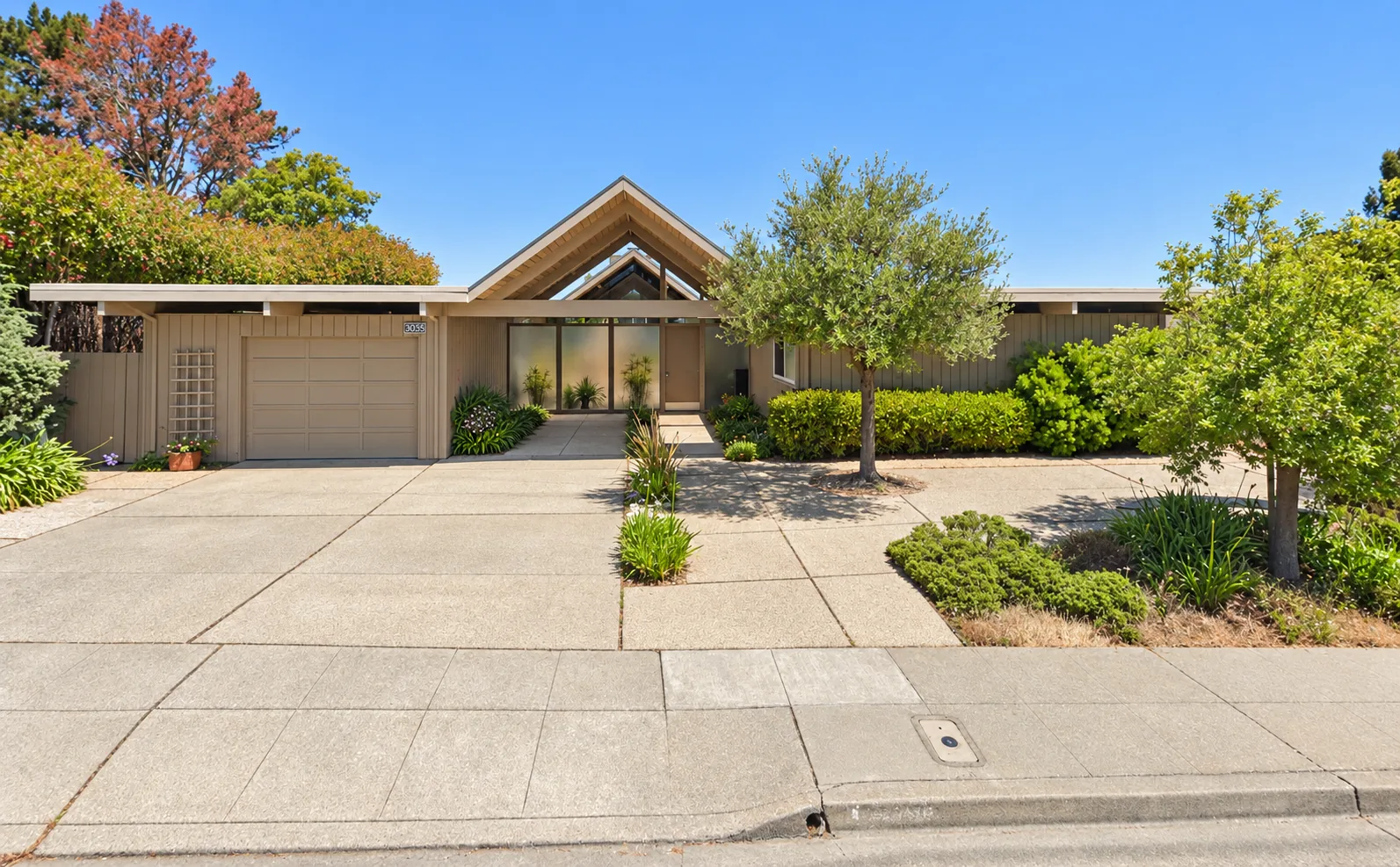
| Roof form | A documented folded plate is the rarest thing in this tract and one of the rarer Eichler roof forms anywhere. A flat-deck house is the norm. Buyers who know the difference pay for it; buyers who do not, do not. | Up, narrow buyer pool |
| Atrium | At 2999 Frontera Way the atrium is 428 sq ft — real square footage that usually does not count as living area. Whether that reads as luxury or as wasted space is the most polarising thing in an Eichler showing. Atriums → | Up for the right buyer |
| Slab and radiant system | 1964–65 copper radiant tubing in a slab is at or past the end of its design life. A documented repipe or a working original system with records is worth real money; an unknown system is a discount and a negotiation. | Down when undocumented |
| Glass and envelope | Single-glazed floor-to-ceiling glass is original and is also the comfort and energy complaint. Sympathetic upgrades hold value. Aluminium sliders in the wrong proportion do not. | Both ways |
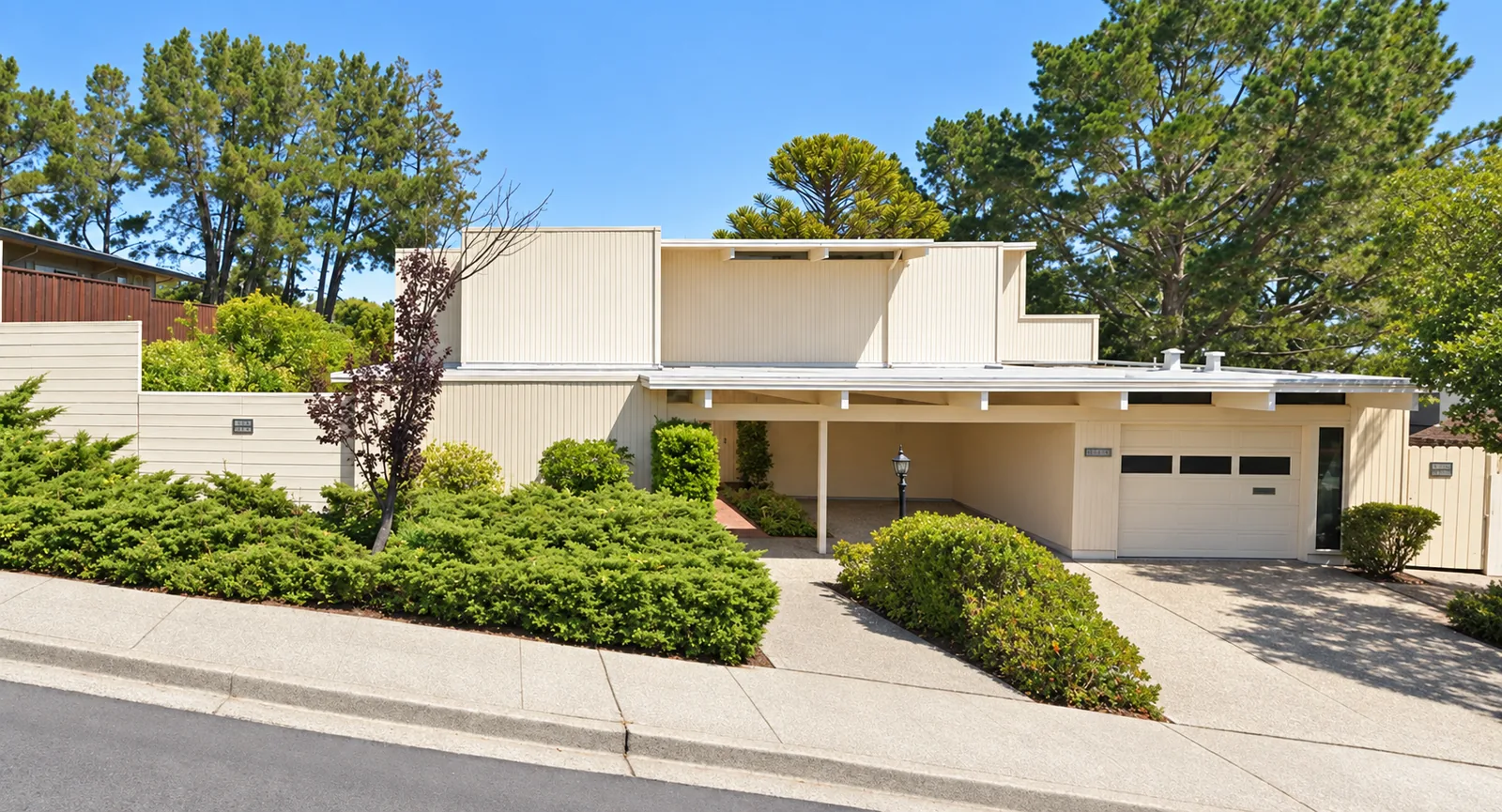
| The hillside | Mills Estate is a hillside subdivision, so lot geometry, drainage and retaining structures vary far more house to house than they do on the flat Eichler tracts. This is where Burlingame differs most from Foster City. | House-specific |
| City of Burlingame status | City services and Burlingame city schools — a direct consequence of the 1946–51 annexation — rather than unincorporated county. This is the structural advantage over the Highlands and it is permanent. | Up, and stable |
The comparable problem
There may be no recent Eichler sale on your street. That is normal here.
With three to six sales a year across eight streets, the probability that a genuinely comparable Eichler sold near you in the last six months is low. Pretending otherwise — reaching for a sale that is the wrong roof, the wrong condition or the wrong year — is how appraisals go wrong in this tract.
Our approach is to build the comparable set in three rings and be explicit about which ring each sale came from:
Every figure we give you carries its ring. A number without one is a guess with good posture.
Plain statement
We are not going to print a median for a hundred-house tract.
Several sites will give you one. It will be a three-sale average, or a polygon median mixing Eichlers with houses that are not, and it will move thirty per cent year to year for no reason connected to anything.
What we will do is run your house through the seven factors above, build the three rings with the addresses named, and show you the spread rather than the point. If the spread is wide, you should know that. It usually is, in this tract.
Market figures we quote for 94010 are computed from public sold records over a rolling twelve months and are re-verified against MLS before they go in anything you would rely on. Nothing on this page is an appraisal, and nothing on it is investment advice.
What we still do not know → · Where all of this comes from →
Talk to us
What is yours actually worth?
Tell us the street and roughly what has been done to the house. You get the three rings, the addresses behind them, and the adjustments written out — not a number with nothing under it.