Burlingame Eichlers / Against the Highlands
Four miles apart
Two ridges. Opposite in almost every way that matters.
Mills Estate and the San Mateo Highlands are both Eichler tracts on San Mateo County hillsides, close enough to drive between in ten minutes. One has a hundred houses and the other has six or seven hundred. One is in a city; the other is in no city at all.
Burlingame
~100
Late, large, inside a city
Highlands
~650–700+
Earlier, smaller, unincorporated
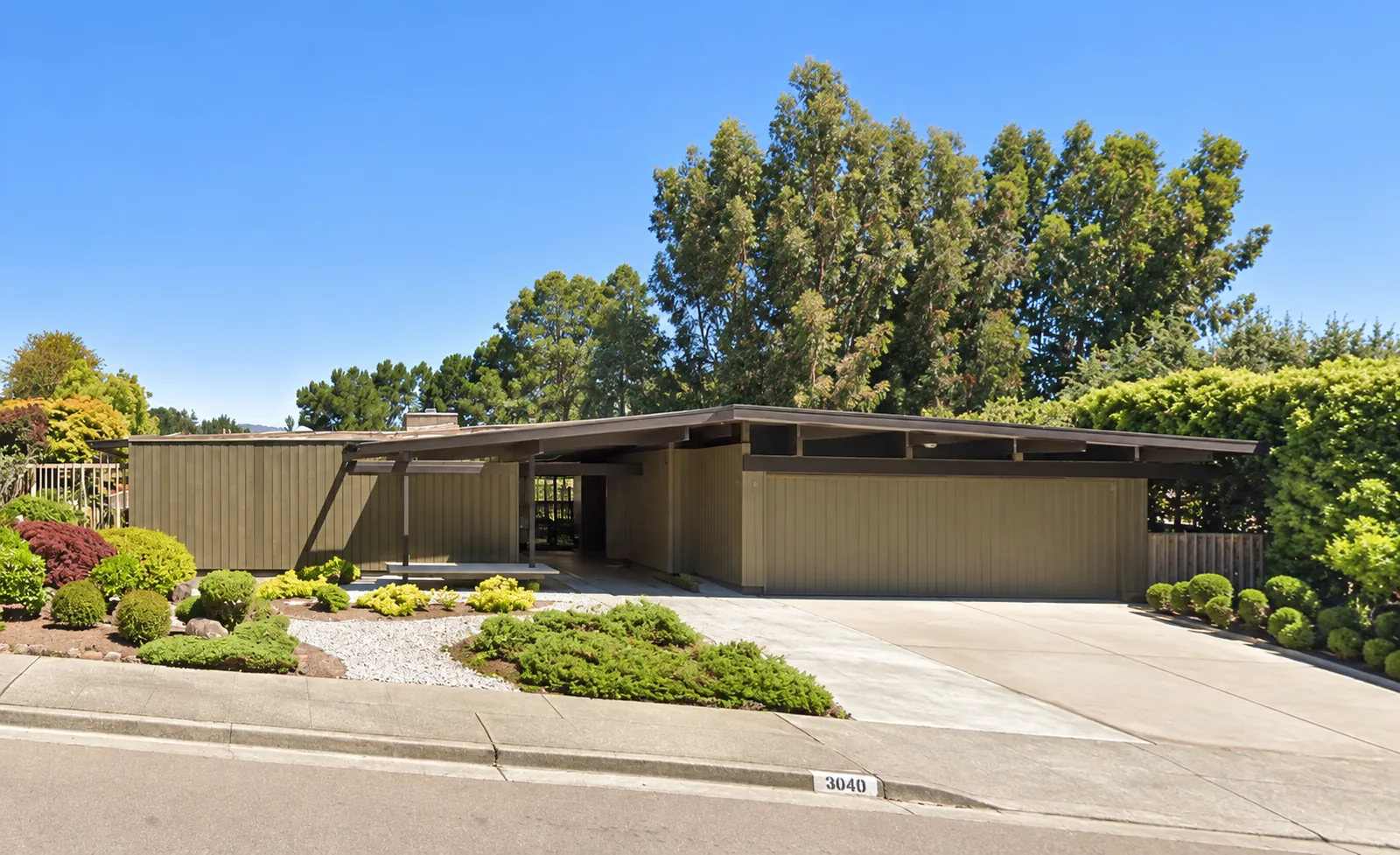
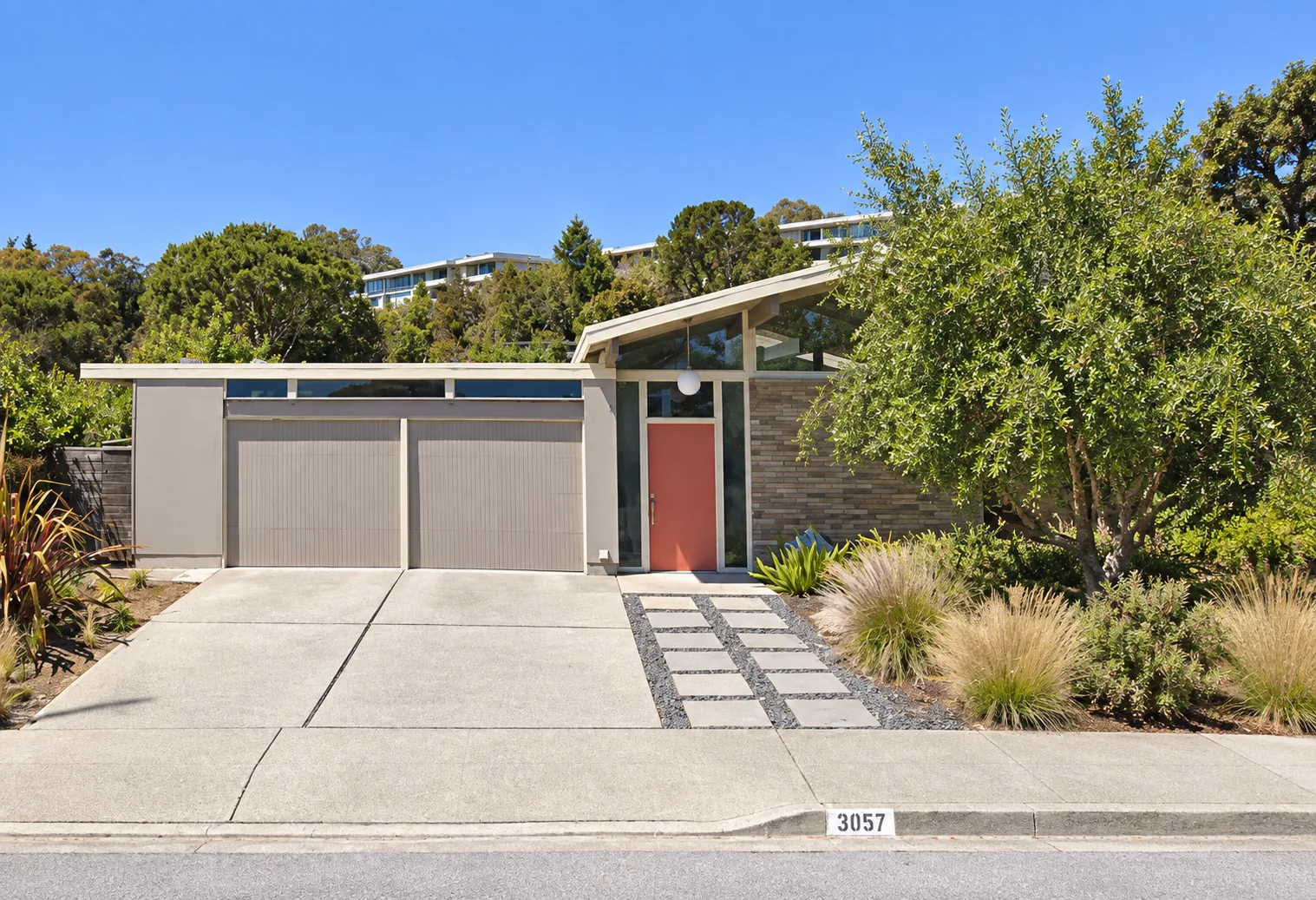
The difference that costs or saves you money
One of these tracts has a planning department. The other does not.
The San Mateo Highlands is unincorporated San Mateo County. There is no single-storey overlay, no design guidelines, no historic district and no homeowners association with architectural teeth. What you may do to an Eichler there is governed by the county building code and very little else. Roughly fifty-five to sixty houses in that tract have had a second storey added.
Mills Estate is inside the City of Burlingame, which operates residential design review. That is a real procedural difference: a review step, a timeline, and a body with an opinion about what your street looks like.
Honest limit: we could not confirm from the City whether any overlay or guideline touches these eight streets specifically. One reference site asserts there is no single-storey overlay and cites nothing. Before you buy here intending to build up, call Burlingame Planning. We are not going to guess on the one question that would cost you the most to get wrong.
Which way that cuts depends entirely on what you are.
If you want to change the house — add a storey, extend, reconfigure the front — the Highlands is materially easier, and demonstrably so: people have done it there, repeatedly.
If you want the street to stay looking like 1964, Burlingame's review is the thing protecting your view of your neighbour's roofline. In the Highlands nothing is. That tract has no protection of any kind, which is a genuine long-term risk to the character people buy it for.
Neither is better. They are opposite bets on the same question.
Era
A decade apart, and it shows in the square footage.
The Highlands was built from the mid-1950s to 1964, and most of it is 1950s work: the brochures give plans at 1,822 and 1,838 square feet, with prices from $17,950 to $21,950. Anshen & Allen and Jones & Emmons drew most of it.
Mills Estate is 1963–65 throughout — Claude Oakland's period. The verified houses run 2,135 to 2,440 square feet. By December 1965 the Highlands two-storey plans were being asked $39,750 and $41,500, which tells you how far the whole market had moved in the seven years between the two tracts.
The Highlands has the better documentary record by a wide margin, and it is not close. Seven original sales brochures survive — four on archive.org and three we hold ourselves — with plan numbers, square footage, prices, GI and FHA terms, and the names of sixteen suppliers.
For Burlingame there is no brochure, no price list, no plan number and no period advertising that we have been able to find. That asymmetry is the single biggest reason this site is shorter than our San Mateo one, and it is not for want of looking.
And one thing the Highlands has that nowhere else does
The X-100.
At 1586 Lexington Avenue in the Highlands stands the house Jones & Emmons framed in steel for Eichler in 1956 and never repeated. A hundred and fifty thousand people walked through it when it opened. It is the only Eichler-related National Register listing in San Mateo County.
Burlingame has no equivalent, and it would be dishonest to invent one. What Burlingame has instead is scarcity and size — a hundred of the biggest Eichlers in the county — and a folded-plate roof that may be the rarest in the Eichler canon, if we can ever find it.
The Highlands is the largest Eichler neighbourhood anywhere, and the highest elevation Eichler tract.